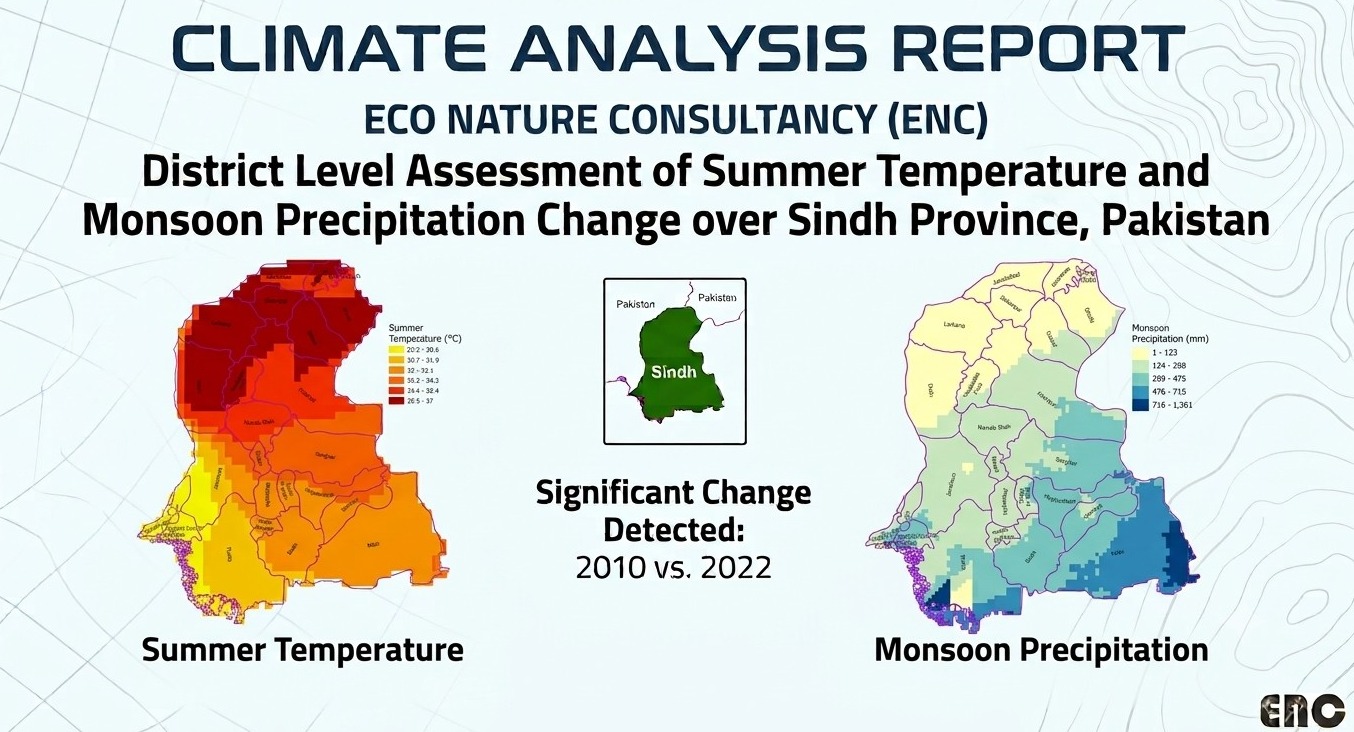
District Level Assessment of Summer Temperature and Monsoon Precipitation Change over Sindh Province, Pakistan
This report presents a district level zonal statistics analysis of summer temperature and monsoon precipitation change across Sindh province, Pakistan, comparing the years 2010 and 2022. Every figure in this report is a direct zonal mean computed in ArcGIS Pro from the underlying ERA5 (temperature) and CHIRPS (precipitation) raster grids, clipped to the boundary of each of Sindh's 27 districts. These ArcGIS Pro results were independently cross checked against a second, separately coded zonal statistics computation run on the same raster and boundary layer; the two methods agreed to within a few hundredths of a degree and a few millimeters for 26 of the 27 districts, and an initial discrepancy on the 27th (Rann of Kutch, an irregular marsh/wetland boundary) was resolved in favour of the ArcGIS Pro result used throughout this report, since it was computed directly in ENC's own production GIS environment. Two clear, unambiguous results emerge from the district level statistics. First, mean May-July temperature fell in every single one of the districts between 2010 and 2022, by amounts ranging from about 0.4°C (in the Karachi districts) to 1.67°C (in Larkana). Second, mean monsoon (JJAS) precipitation rose in every single district over the same period, by amounts ranging from about 6% (Mithi/Tharparkar) to over 160% (Naushahro Firoz), with the largest relative increases concentrated in upper Sindh (the Sukkur and Larkana administrative divisions). These two findings, read together, are consistent with independent documentation of 2022 as an anomalously wet, and comparatively less extreme pre-monsoon-heat, year for Sindh compared with 2010 not evidence of a cooling climate. The wider, independently published literature on Sindh (reviewed in Section 4.3) shows a long-term warming trend of roughly 0.1-1.4°C in mean annual temperature since 1990 and a rising trend in monsoon rainfall intensity; the two years compared here are simply two points of substantial year to year variability sitting on top of that slower trend. The report closes with recommendations for extending this exercise into a standing, multi-year ENC climate-monitoring product.